For Team Stone, doctrine, family-project and general questions.
K6RCS · GEARS · Field Day · Chico
Radio is more useful when somebody else learns why it works.
Radio started with listening, curiosity and some youthful transmitting that is properly described as unlicensed. The licensed record began in 2004 and grew into a practical mix of local voice, HF, data, digital systems, teaching and field communication.
Free ham radio practice exams
Practice the actual NCVEC question pools.
Technician, General and Amateur Extra exams use the current public question pools and official diagram questions. Full practice tests follow the published exam blueprints, and the engine runs locally in the browser.
409 Technician questions · 423 General questions · 599 Amateur Extra questions · ARRL instruction available with no teaching fee.
Radio in practice
Operating, teaching and club work
The station record is stronger when it shows radio being used, not only equipment and menus.
Team Stone digital contact
BrandMeister TG 3173147 — Group Call. K6RCS and Team Stone welcome calls; monitoring is intermittent. Arrange a time for dependable contact and use your own assigned source ID.
What a public digital contact reveals · Current operating doctrine
Signal, teaching, field use
Radio is equipment, path, practice, and people.
I am an ARRL instructor and do not charge for amateur-radio licensing instruction. If travel is required, I may ask for reimbursement of the actual travel or transportation cost. Licensing help and free practice exams →
2004First formal amateur license
80m–70cmRegular operating range
206608EchoLink node
10+ yearsGEARS board service and teaching era
Usually monitoring: GEARS East 146.850 MHz (-600 kHz), tone 110.9 Hz.
Fixed, portable, and mobile radios can take the local watch as operating conditions require. “Usually monitoring” describes the operating plan, not a promise that a particular radio or operator is continuously present.
What I operate
RF first. Networks where they add reach. Clear labels everywhere.
The site separates direct radio, repeaters, APRS, linked networks, internet-assisted systems, GMRS, marine radio, and receive-only material. They are useful for different reasons and governed by different rules.
HF and local radio
Digital, SSB, AM, FM, CW, and SSTV from 80 meters through 70 centimeters.
Operating →APRS
Position, messaging, road awareness, and the old-school 100 Hz Voice Alert layer on the TM-D700A fleet.
APRS →QSO One
A broad software console for linked systems, travel-region access, and rapid deployment.
QSO One →Winlink and RadioMail
Store-and-forward messaging when ordinary internet access is thin or unavailable.
Winlink →Nets & linked access
Current home and travel skeds, GEARS RF/AllStar/EchoLink, WIN on-request access, W6EK, SNARS and PNWDigital.
Nets & access →The station begins outside the radio
Antenna, elevation, path, noise, timing, then equipment.
The Home QTH is less “one antenna system” than a small argument among feed lines. The IC-756 Pro III switches among the Mosley 20/15/10-meter beam and the 80-meter loop, which gets more actual use than anything else; a 40-meter dipole normally joins that switch but is down for replacement. VHF/UHF work is split among the roof-mounted Arrow 2m/70cm J-pole on the secondary FT-897D, a dedicated roll-up J-pole for the shack FT-5DR, a Workman III triple-collinear on the QTH TM-D700A, and a smaller Workman II available for the FT-2400. A quick-connect is next so the FT-5DR can borrow the Arrow when wanted, one radio at a time.
Every fixed antenna path provides a DC or static-drain path to ground. All fixed antennas except the 80-meter loop are fully DC grounded through their antenna and/or switched-feed arrangements. The loop is not fully DC grounded; its lightning arrestor and grounded shunt provide its static-drain path. Those arrangements help discharge static, quiet receiver noise, and support the station’s overall lightning-safety system; they are not a claim of lightning immunity.
The radios matter. The path still gets the final vote.
Field radio
The backcountry supplies honest test conditions.
Snow camping, backcountry skiing, whitewater kayaking, running, EUC travel, and long road trips expose weak power plans, poor cable choices, unrealistic antennas, and software that requires an internet connection to explain why it has no internet connection.
Go-kits are organized by task: voice, position, message, power, charging, antenna, weather, and documentation.
Primary resources
Use the actual tools and source material.
Digital field guides
Stop configuring by folklore.
DMR, C4FM/WIRES-X, D-STAR, NXDN, P25, M17, AllStar and EchoLink now share one K6RCS troubleshooting model: identify the layer, prove it, then move outward.
Reach K6RCS
Callsign first. Route second.
Email and telephone remain the durable public front door. Radio operators can use the station identities and usual hangouts below to evaluate a path or propose a sked; none implies continuous monitoring.
Best for a question that should survive propagation, batteries and whether I happen to be near a radio.
Telephone
The public line. Routing happens behind it; no family mobile number needs to be published.
EchoLink
A direct directory identifier when the station is logged in. It is not permanently online.
DMR
The station identity—not a talkgroup, room or claim of presence on every DMR network.
APRS
Useful for short amateur-radio traffic. Delivery is not guaranteed, and APRS activity can be publicly visible.
Winlink
Asynchronous store-and-forward messaging. Do not send confidential, urgent or deadline-dependent material.
GEARS East
146.850 · −600 · tone 110.9
W6RHC and the primary QTH club anchor. Usually monitored is still not the same thing as staffed.
AllStar
57364 · 56934 · 51018 · 2560 · 55915
GEARS VHF/UHF, W6EK, WIN and Bay-Net. QSO One is the normal fixed-site client; monitoring and node availability remain intermittent.
APRS Voice Alert
144.390 · PL 100.0
On compatible TM-D700A installations: a brief alert and callsign, then move the voice exchange elsewhere.
Propose a sked
Include the date, time and time zone, band, mode, proposed frequency or linked destination, and a fallback route.


Radio is public and fallible. These routes are not private, not continuously monitored and not appropriate for emergency traffic. Skeds are welcome; publish enough detail to establish the contact without publishing credentials, private schedules or sensitive traffic.
Personal radio contact
If the radio route does not fit the question, use the ordinary one.
Email is the durable default. If you want a text reply or radio-related follow-up by SMS, the optional box below is separate and starts unchecked.
Social & sharing
Share-ready artwork
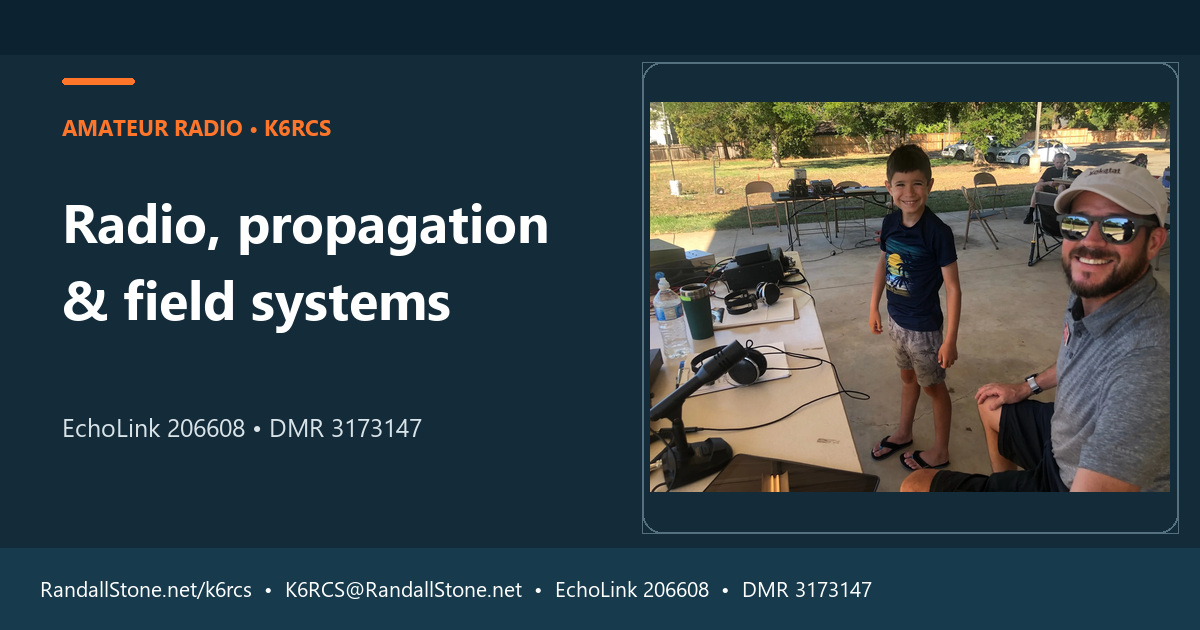
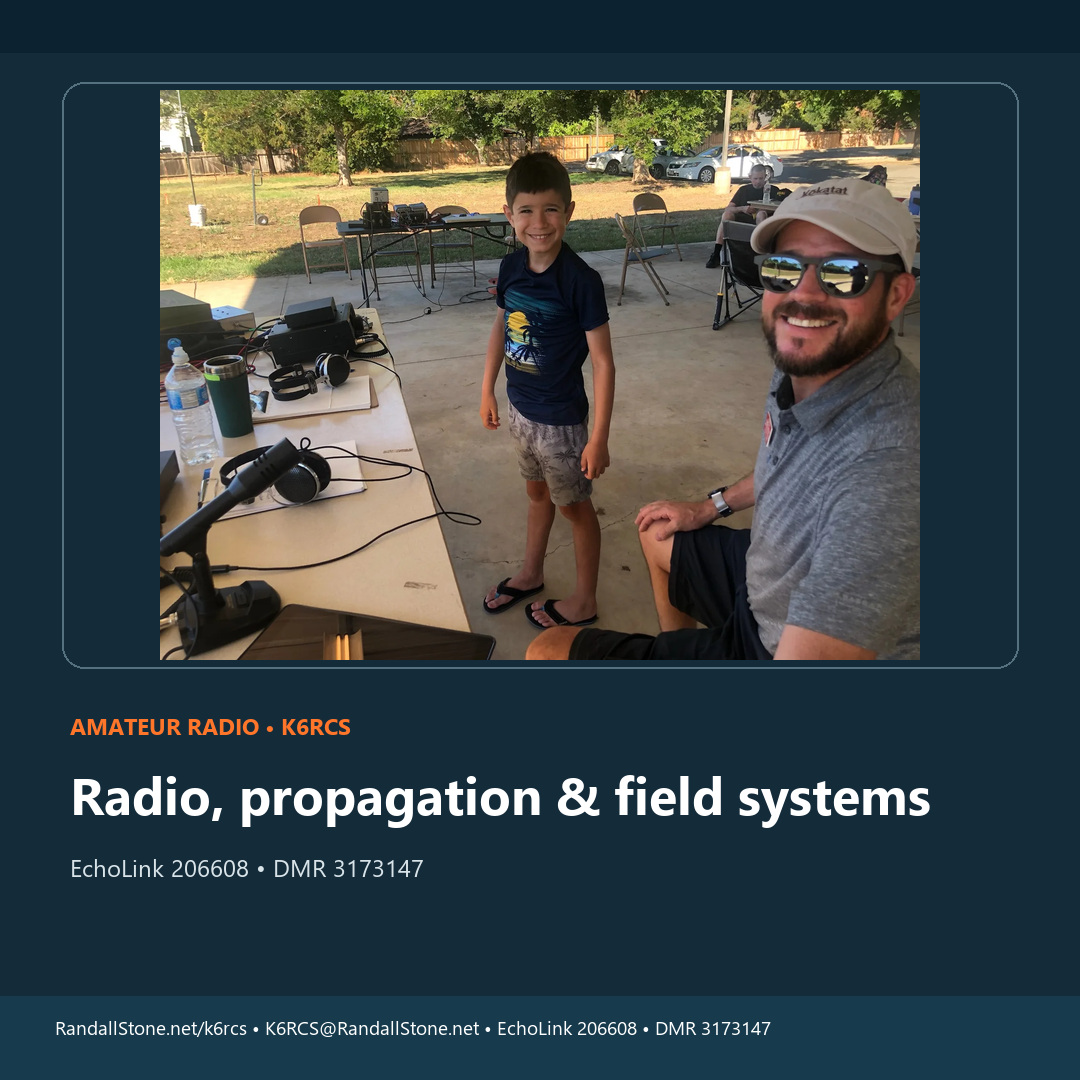
Branded landscape and square artwork are kept with the property instead of hidden in a release archive. The landscape card is optimized for link previews; the square tile is built for social posts and profile-driven sharing.
Field fleet · October 12, 2026
Four UV-5R Mini handhelds carry the family field role.
The assigned radios are Randall orange, Krista yellow, Rhys blue, and Karden green. They supersede the failing BTECH UV-5X3 handhelds for routine family field use. The remaining UV-5R3 is a demoted reserve because its proprietary charger makes it a poor fleet standard.
The UV-5R Mini is not the standard UV-5R. Use Mini-specific manuals and programming profiles. Baofeng documents keypad, CPS, CHIRP, and OLA Radio programming, plus a 2-pin Kenwood accessory jack. Internal Bluetooth supports programming only; it does not provide native Bluetooth speaker-microphone audio.
OLA evaluation: hardware validation is pending. Use a single-radio trial, preserve the known-good image, write a noncritical change, and verify the entire memory set before using OLA across the fleet.
Rhys and Karden already have speaker microphones. Randall and Krista need two inexpensive wired K-plug microphones. Bench-test each microphone on the exact Mini before field issue. TIDRADIO lists the Q2L plus BL-2 adapter as a wireless option for the Mini, but the adapter is additional hardware and reports show that plug seating can affect PTT, so it is not the default purchase.